Upgrading bedroom lighting with LEDs delivers more than energy savings, it unlocks precise control over ambiance, color temperature, and long-term operating costs. LEDs have evolved far beyond the harsh, cold bulbs of a decade ago. Today’s options range from dimmable warm-white fixtures to smart systems that adjust automatically throughout the day. For DIYers looking to modernize a bedroom without rewiring or hiring an electrician, LED retrofits and plug-in solutions offer practical, high-impact improvements. This guide walks through selecting, installing, and optimizing LED lighting for bedrooms in 2026.
Table of Contents
ToggleKey Takeaways
- LED bedroom lighting cuts energy consumption by approximately 85% compared to incandescent bulbs while providing 15–25 years of lifespan and eliminating excess heat output.
- Choose warm white LEDs (2700K–3000K) for ambient bedroom lighting to reduce blue-light exposure and promote relaxation, while reserving neutral white (3500K–4000K) for task areas like closets or vanities.
- LED bedroom lighting solutions range from integrated ceiling fixtures and retrofit kits to flexible strip lights and puck lights, offering DIY-friendly options without rewiring.
- Smart LED systems enable automation through dimming schedules, voice control, and adaptive lighting that adjusts color temperature throughout the day to support circadian rhythms.
- Proper placement and layered lighting—combining overhead fixtures, task lights, and accent lighting on separate switches—maximizes both functionality and ambiance while avoiding glare directly above the bed.
- Always confirm circuit power is off with a voltage tester before installation, match dimmer types to LED loads to prevent flickering, and use IC-rated fixtures in insulated ceilings.
Why LED Lighting Is the Best Choice for Bedrooms
LEDs outperform incandescent and CFL bulbs across every metric that matters in a bedroom: energy efficiency, lifespan, heat output, and dimming capability. A typical 60-watt-equivalent LED draws only 8–10 watts while producing the same lumens, cutting electricity use by roughly 85%. Over a rated lifespan of 25,000–50,000 hours, that translates to 15–25 years of use at three hours per day, far longer than the 1,000-hour lifespan of incandescent bulbs.
Bedrooms benefit especially from low heat emission. Incandescent bulbs waste 90% of their energy as heat, which matters in smaller rooms or during summer months. LEDs run cool to the touch, reducing HVAC load and eliminating burn risks on lampshades or ceiling fixtures.
Dimming compatibility is critical for bedrooms, where lighting needs shift from morning routines to evening relaxation. Modern LEDs pair with standard dimmer switches, though older dimmers designed for incandescent loads can cause flickering. Look for TRIAC or ELV dimmers rated for LED loads, or choose bulbs labeled “dimmable” with a specified minimum dimming range (typically 10–100%).
Finally, LEDs contain no mercury, unlike CFLs, making disposal simpler and safer. While they’re not hazardous waste, many retailers and municipal programs offer recycling to recover rare-earth materials.
Types of LED Bedroom Lighting Solutions
Overhead and Ceiling LED Fixtures
Flush-mount and semi-flush LED fixtures replace traditional ceiling-mounted bowls and are the workhorse of bedroom lighting. These fixtures integrate LED arrays directly into the housing, eliminating the need for separate bulbs. Look for units with integrated drivers (the LED equivalent of a ballast) that are replaceable or come with a manufacturer warranty of at least five years.
For rooms with existing recessed cans, LED retrofit kits drop into standard 4-inch, 5-inch, or 6-inch housings. These kits include a trim ring and an integrated LED module that screws into the existing Edison socket. Most retrofits are rated for insulated ceilings (IC-rated) and wet or damp locations if needed in basements or older homes.
Ceiling fans with integrated LED light kits have become common. When replacing a fan, verify that the down-rod and mounting bracket can support the combined weight. Most bedroom fans use a standard 15-amp, 120-volt circuit, which is adequate unless adding multiple high-wattage devices on the same breaker.
For vaulted or tray ceilings, adjustable gimbal trims let the homeowner aim light where needed, useful for highlighting artwork or providing task lighting near a reading chair.
LED Strip Lights and Accent Lighting
Flexible LED strip lights (also called tape lights) run on low-voltage DC power, typically 12V or 24V, supplied by a plug-in transformer. Strips are available in IP ratings from IP20 (indoor, dry locations) to IP65 (dust-tight, water-resistant), though bedrooms rarely need more than IP20.
Strips come in densities measured in LEDs per meter, 60 LEDs/m for general accent work, 120 LEDs/m for uniform, dot-free illumination. They install with adhesive backing along headboards, under floating nightstands, inside closets, or behind crown molding for indirect cove lighting.
When cutting strips to length, follow the marked cut lines (usually every 2–4 inches). Solderless connectors or snap-on clips rejoin sections, though soldering provides a more reliable connection for permanent installations.
Puck lights and LED spotlights work well in walk-in closets or as reading lights mounted to the wall. Battery-powered options eliminate wiring but require AA or rechargeable lithium cells every few months. Hardwired pucks typically daisy-chain on a single low-voltage run, keeping installation within DIY scope.
Choosing the Right Color Temperature for Your Bedroom
Color temperature, measured in Kelvin (K), defines the visual warmth or coolness of white light. Bedrooms generally benefit from warmer tones that promote relaxation, while task areas like vanities or reading nooks may call for neutral white.
2700K–3000K (warm white) mimics the glow of incandescent bulbs and halogen lamps. This range reduces blue-light exposure before sleep, which research suggests can interfere with melatonin production. Most bedside lamps, ceiling fixtures, and ambient lighting fall into this range.
3500K–4000K (neutral white) offers a crisper light suitable for walk-in closets, makeup areas, or home offices integrated into a bedroom. It renders colors more accurately than warm white, which can shift toward amber or yellow.
5000K+ (daylight/cool white) is rare in bedrooms but occasionally used in craft rooms or spaces requiring maximum visual clarity. It feels clinical in most residential settings.
Tunable white or color-changing LEDs allow adjustment across the full spectrum. Smart bulbs and strip lights often include this feature, enabling the homeowner to shift from energizing 4000K light in the morning to calming 2700K at night. Some systems sync with circadian rhythms or local sunrise/sunset times.
When mixing fixtures, stay within 200–300K of each other to avoid a disjointed look. Pairing 2700K ambient lighting with 4000K task lighting in the same sightline creates visual tension. If both are needed, use separate switches or zone controls.
Smart LED Lighting Features and Controls
Smart LEDs connect via Wi-Fi, Zigbee, or Z-Wave to smartphone apps, voice assistants, or dedicated hubs. Wi-Fi bulbs work standalone but can congest a home network if dozens are installed. Zigbee and Z-Wave require a hub (such as SmartThings, Hubitat, or Amazon Echo Plus with Zigbee) but create a mesh network that extends range and improves reliability.
Dimming and scheduling are the most-used features. Homeowners can program lights to fade on gradually in the morning or dim automatically at a set bedtime. Most apps allow scene creation, “Reading” might set bedside lamps to 80% at 3500K, while “Movie” drops overhead lights to 20% warm white.
Motion and occupancy sensors trigger lights when someone enters, useful in walk-in closets or en-suite bathrooms. Sensors with adjustable sensitivity and timeout settings prevent false triggers from pets or HVAC airflow.
Voice control through Alexa, Google Assistant, or Apple HomeKit allows hands-free operation. Compatibility varies by manufacturer, so verify integration before purchasing if voice control is a priority.
Some systems support adaptive lighting, which adjusts color temperature and brightness based on time of day or ambient light levels measured by a sensor. This feature is most effective when paired with tunable white LEDs.
Installation mirrors standard bulbs, screw in the smart LED, download the manufacturer’s app, and follow pairing instructions. Most systems require a 2.4 GHz Wi-Fi network (5 GHz is incompatible with many smart bulbs). For renters or those avoiding app ecosystems, smart plugs control non-smart LEDs on schedules or via voice, though dimming isn’t possible without a compatible dimmer.
Installation Tips and Placement Strategies
Turn off power at the breaker before replacing any hardwired fixture. Use a non-contact voltage tester to confirm the circuit is dead, never rely on the switch alone. If the existing fixture is heavy (ceiling fans, chandeliers), get a second person to support it while disconnecting.
When retrofitting recessed cans, check whether the existing housing is IC-rated (safe for contact with insulation) or requires clearance. LED retrofits generate less heat than incandescent, but building codes still require IC-rated fixtures in insulated ceilings.
For strip lighting, clean the mounting surface with isopropyl alcohol before applying adhesive backing. Dust or paint texture reduces bond strength. In high-vibration areas (near doors or ceiling fans), add aluminum channels that hold strips mechanically and double as heat sinks and diffusers.
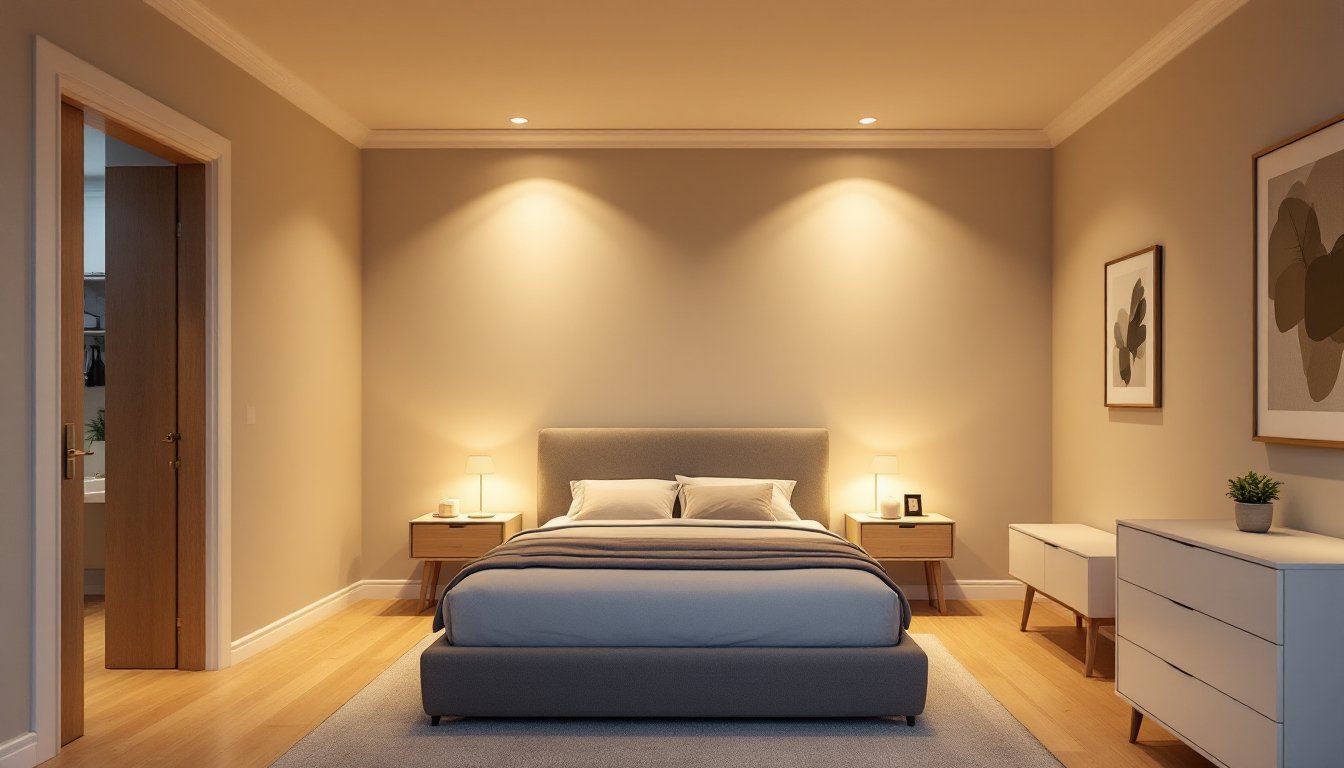
Layered lighting improves functionality and ambiance. Combine overhead fixtures (general illumination), task lights (reading lamps, closet spots), and accent lights (strips behind headboards, wall sconces). Each layer should be on separate switches or smart controls.
Place bedside lamps 24–27 inches above the mattress top for comfortable reading without glare. Wall-mounted swing-arm lamps save nightstand space and allow precise positioning.
Avoid placing bright overhead lights directly above the bed. This creates glare when lying down. Instead, position recessed cans in a grid around the bed perimeter or use semi-flush fixtures with frosted diffusers.
For dimmers, match the dimmer type to the LED load. Leading-edge (TRIAC) dimmers work with most LEDs but may cause buzzing at low levels. Trailing-edge (ELV) dimmers are quieter but cost more. Install the dimmer, then test the full range. If flickering or buzzing occurs below 20%, the dimmer and bulb may be incompatible.
Safety gear: Wear safety glasses when working overhead, especially when removing old fixtures or drilling. Use a sturdy step ladder with a tool tray, never stand on furniture. If running new wire for additional fixtures, consult local electrical codes. Most jurisdictions require permits for new circuits, though replacing existing fixtures on the same circuit rarely does.