Good outdoor lighting does more than help homeowners find their keys at night. It transforms a home’s curb appeal, adds security by deterring intruders, and extends usable outdoor space long after sunset. Whether someone’s replacing a single porch light or lighting up an entire façade, the right fixtures and placement make all the difference. This guide covers the essentials, from selecting the right fixture types to wiring safely and planning a layout that balances function and aesthetics. No fluff, just practical steps for getting exterior lighting done right.
Table of Contents
ToggleKey Takeaways
- Outdoor lighting on your house serves three essential functions: improving safety by lighting pathways and steps, enhancing security by deterring break-ins, and boosting curb appeal and property value.
- Wall-mounted sconces and porch lights should be scaled proportionally to your door (roughly one-quarter the door height) and mounted 60–66 inches above the porch floor for optimal aesthetics and function.
- Layered lighting using task (entries and pathways), accent (uplighting architectural features), and ambient (background fill) creates balanced, inviting outdoor lighting that avoids harsh shadows and dark spots.
- Low-voltage LED landscape lighting offers safer, more flexible installation than line-voltage systems, with cable runs extending 100+ feet and fixtures typically spaced 8–10 feet apart for consistent coverage.
- LED bulbs are the superior choice for outdoor lighting due to their 15,000–50,000 hour lifespan, energy efficiency, and reliability in temperature swings; use warm white (2700K–3000K) for residential spaces.
- Smart outdoor lighting systems and motion sensors add convenience and energy savings, but focus smart features on high-use zones like entries and driveways rather than upgrading every fixture.
Why Outdoor House Lighting Matters
Outdoor lighting serves three core functions: safety, security, and aesthetics. Well-lit pathways, steps, and entryways reduce trip hazards and help visitors navigate unfamiliar terrain after dark. Studies show that homes with visible exterior lighting experience fewer break-ins, motion-activated floods and illuminated entry points make properties less attractive targets.
Beyond practicality, strategic lighting highlights architectural features, landscaping, and textures that disappear at night. A well-placed uplight can showcase a stone chimney or mature tree, while sconces flanking a front door add symmetry and dimension. Poor lighting, on the other hand, creates harsh shadows, washes out details, or leaves dark pockets that feel uninviting.
Lighting also affects property value. Real estate agents consistently note that homes with updated exterior lighting photograph better and make stronger first impressions during evening showings. It’s one of the few upgrades that delivers both immediate utility and long-term return.
Types of Outdoor Lighting for Your Home
Wall-Mounted and Porch Lights
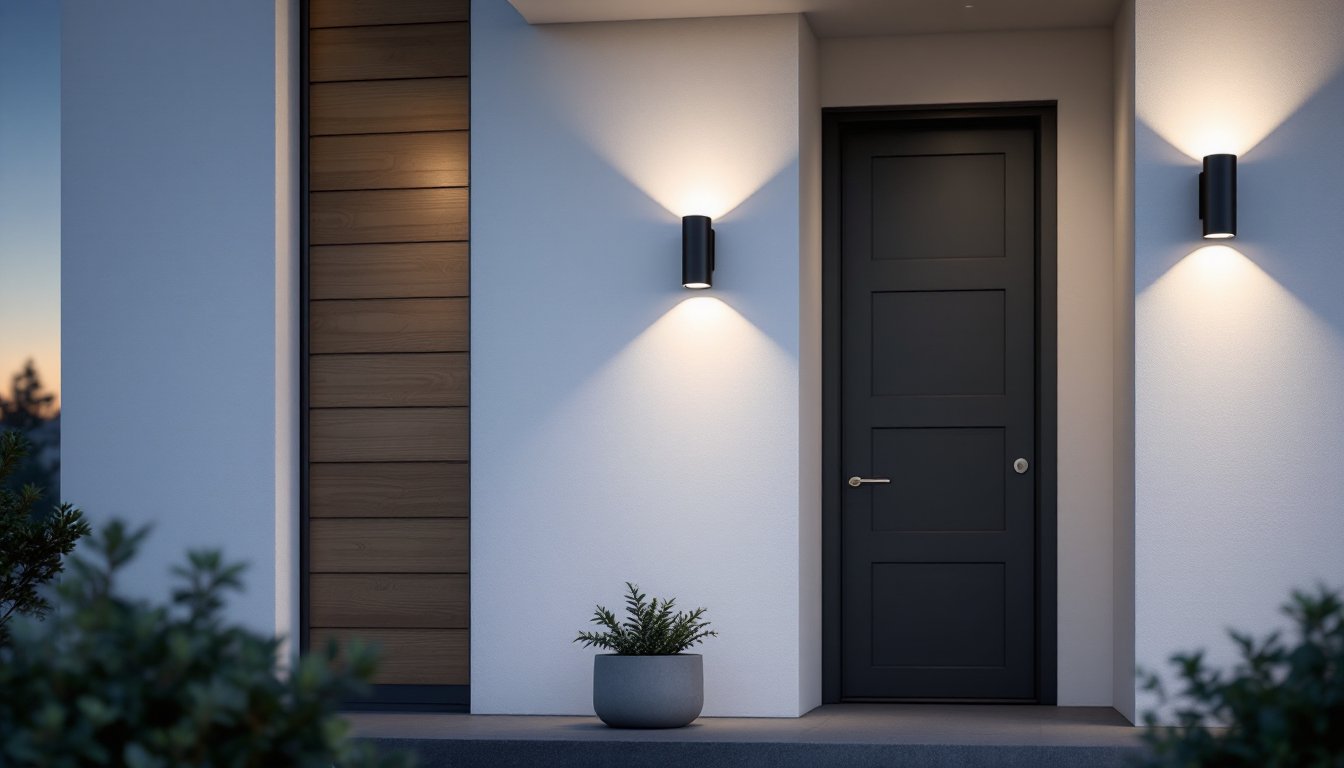
Sconces and lanterns are the workhorses of exterior lighting. Installed beside entry doors, garage openings, or along covered porches, they provide ambient light and serve as visual anchors. Most mount to a standard electrical box recessed into the wall or siding.
When selecting wall fixtures, homeowners should match the scale to the door or wall surface, a common rule is that the fixture height should be about one-quarter the door height. For an 80-inch door, that means a 20-inch fixture. Wet-rated fixtures (UL listing for direct exposure to rain) are required in uncovered locations: damp-rated fixtures work under eaves or covered porches.
Porch ceiling lights and flush-mount fixtures work well in areas with low clearance. These typically use standard A19 or A21 bulbs or integrated LEDs. For higher ceilings or open porches, pendant lights add character but require more headroom, allow at least 7 feet of clearance below the fixture.
Accent and Landscape Lighting
Low-voltage landscape lighting (typically 12V systems) offers flexibility for highlighting trees, shrubs, pathways, and architectural details. These systems run on a transformer that steps down household 120V current, making installation safer and more forgiving than line-voltage work. Cable runs can extend 100 feet or more from the transformer, depending on wire gauge and fixture load.
Common landscape fixture types include:
- Path lights: Low-profile fixtures that illuminate walkways and garden borders, usually spaced 8–10 feet apart.
- Spotlights and well lights: Directional fixtures for uplighting trees, walls, or features. Adjustable beam angles (narrow spot to wide flood) let homeowners control the effect.
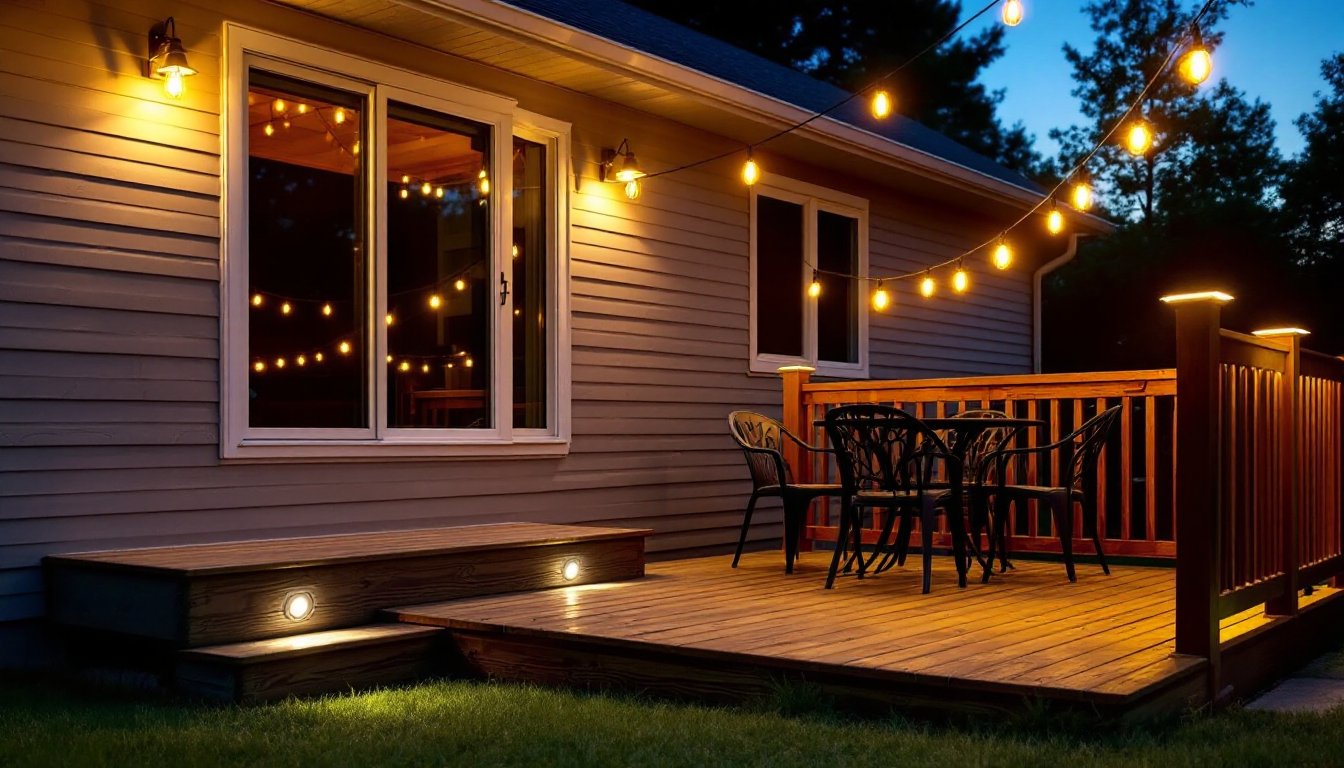
- Deck and step lights: Recessed or surface-mount fixtures that tuck into risers, post caps, or railings to improve safety on stairs and elevated surfaces.
Line-voltage (120V) landscape lighting is less common but useful for high-output applications like lighting tall trees or long driveways. These require GFCI protection and burial-rated cable (typically UF-B) at code-compliant depths, usually 12 inches minimum when protected by conduit, 18–24 inches otherwise, depending on local code.
How to Plan Your Outdoor Lighting Layout
Start by walking the property at dusk with a notepad. Identify areas that feel unsafe, uninviting, or invisible, dark steps, shadowy corners, entries without definition. Note features worth highlighting: stone veneers, columns, mature plantings, or trim details.
A balanced lighting plan layers three types:
- Task lighting: Focuses on function, entry doors, pathways, garage approaches, outdoor kitchens.
- Accent lighting: Adds drama and depth, uplights on architecture, downlights in trees, grazing lights on textured walls.
- Ambient lighting: Fills in background illumination, post lights, soffit-mounted fixtures, or diffused porch lights.
Map out fixture locations on a simple site sketch. For wall-mounted fixtures, center them on doors or windows, typically 60–66 inches above the porch floor (or one-third the distance between the porch and soffit). Space sconces 8–10 feet apart along long walls to avoid gaps.
For landscape fixtures, use the rule of thirds: position spotlights so they highlight the lower third of a tree or wall feature, allowing the light to climb naturally. Avoid aiming lights directly at windows or neighboring properties, light trespass is a common complaint and can violate local ordinances.
Consider control zones. Group lights logically, front entry and driveway on one circuit, backyard and patio on another. This makes it easier to use timers, photocells, or smart switches for independent control. If planning low-voltage landscape lighting, position the transformer near a GFCI outlet and within reach of the farthest fixture run.
Installation Tips and Best Practices
Safety first: Turn off power at the breaker before working on any line-voltage fixture. Use a non-contact voltage tester to confirm wires are dead. Outdoor electrical work must comply with the National Electrical Code (NEC) and local amendments, when in doubt, hire a licensed electrician. Many jurisdictions require permits for new circuits or fixture additions.
When mounting fixtures to siding or stucco, use a weatherproof gasket or self-adhesive foam pad behind the mounting plate to prevent water intrusion. Apply a bead of silicone caulk around the top and sides (leave the bottom open for drainage). For fiber cement, vinyl, or metal siding, predrill holes to avoid cracking or distortion.
All exterior connections should be made inside a weatherproof junction box with a cover rated for wet or damp locations. Use wire nuts rated for outdoor use (often filled with silicone gel) and wrap connections with electrical tape for extra protection. Never leave exposed wire splices, even temporarily.
For low-voltage landscape lighting, bury cable along pathways or bed edges at least 6 inches deep to protect it from foot traffic and garden tools. Use direct-burial cable (not standard lamp cord). Connect fixtures using waterproof wire connectors or piercing connectors designed for low-voltage systems. Avoid daisy-chaining too many fixtures on one run, voltage drop causes dimming at the end of the line. For long runs, use larger gauge wire (12 AWG instead of 16 AWG) or split the circuit.
Test all fixtures before final installation. Check for proper grounding, secure mounting, and correct bulb orientation (especially in directional or shielded fixtures). Install motion sensors or photocells where appropriate, these extend bulb life and reduce energy waste.
Choosing the Right Bulbs and Smart Features
LED bulbs dominate outdoor lighting for good reason: they last 15,000–50,000 hours, use a fraction of the energy of incandescent bulbs, and handle temperature swings without issue. For most porch and wall fixtures, a 9–13W LED (60–75W incandescent equivalent) provides ample light. Choose a color temperature between 2700K and 3000K (warm white) for inviting, residential ambiance. Cooler temps (4000K+) look harsh and institutional.
For landscape and accent fixtures, lower wattages (3–7W LEDs) often suffice. The goal is subtle highlighting, not floodlit yards. Fixtures with adjustable beam angles let homeowners fine-tune spread and intensity without swapping bulbs.
Dimmable LEDs add flexibility, but verify compatibility with dimmer switches, not all LEDs dim smoothly. For outdoor use, choose wet-rated or damp-rated bulbs depending on exposure. Some integrated LED fixtures don’t use replaceable bulbs at all: instead, the entire fixture is replaced when the LED array fails (typically after 10+ years).
Smart outdoor lighting offers control via app, voice assistant, or automation. Smart bulbs (like Philips Hue Outdoor or LIFX) screw into standard sockets and connect via Wi-Fi or Zigbee. Smart switches and dimmers control any fixture from the wall or remotely, useful for grouping multiple non-smart fixtures. Photocell and motion sensors can integrate with smart systems or operate independently for automated on/off cycles.
For homeowners with large properties or complex layouts, low-voltage LED landscape systems with integrated transformers and timers simplify control. Many now include smartphone apps for programming zones, brightness levels, and schedules. Remember that smart features add cost and complexity, not every fixture needs Wi-Fi. Focus upgrades on high-use zones like entries, patios, and driveways where programmable control delivers real convenience.